Field report: Isle of Wight storage cluster investigation
Onsite investigation of a storage fault affecting the virtualisation cluster at a business services company’s main Isle of Wight premises. The initial request was to restore access to the shared datastore and establish why the expected storage failover had not completed.
Assignment record
| ATTENDANCE | 14 November 2013 / Isle of Wight main site |
|---|---|
| CLIENT | Business services company / central operational systems |
| PLATFORM | Virtualisation cluster / three storage servers / shared block storage |
| REPORTED FAULT | Virtual machines unavailable / datastore access errors |
| EXPECTED BEHAVIOUR | Automatic continuation through another DRBD member |
| REQUESTED OUTCOME | Restore service and confirm the storage protection state |
09:12 — Arrival and service state
The engineer attended following reports that several virtual machines had stopped responding overnight. The remaining guests had subsequently become unavailable as the hypervisors encountered storage timeouts. The management network and host consoles remained accessible, but the shared datastore could not be mounted consistently.
The site manager described the installation as a three-member replicated storage cluster. His understanding was that another DRBD member should have taken over when the first server developed a disk problem. The support request was initially treated as a failure of the expected handover rather than a failure of all available copies.
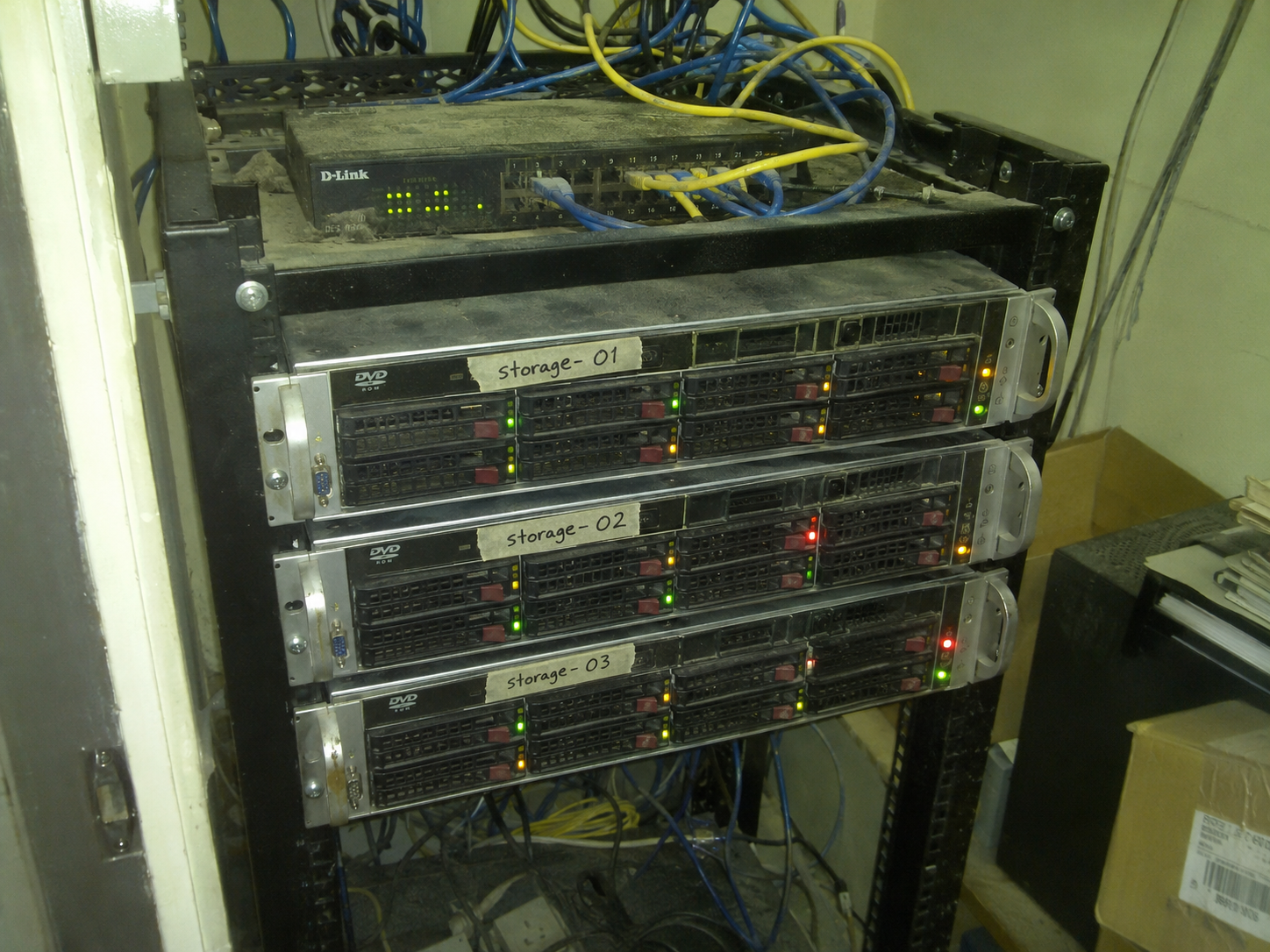
Three storage servers as found. Fault indicators were present on different drive positions.
09:41 — Replication checks
The server names, rack labels and an older handover document referred to primary, secondary and recovery storage roles. The engineer checked the systems for the corresponding DRBD resources and peer state. Configuration files from an earlier arrangement were present, but no active replicated resource could be identified for the production datastore.
Tracing the hypervisor’s block-storage connection led to a single target on the first storage server. That target depended on logical volumes assembled from local storage and network-accessible volumes supplied by the other two machines. The peer servers were providing additional address space to the same device. Neither held a complete alternative copy which could be promoted.
10:23 — Array condition
All three storage servers showed drive failures. The failed members belonged to different underlying arrays and affected different portions of the combined capacity. Controller records included earlier degraded states followed by additional failures for which no completed replacement or rebuild could be found.
Some underlying volumes still responded to limited reads. Others were unavailable, and several returned errors at repeatable offsets. The mixture of accessible and inaccessible regions explained why individual management checks had continued to report storage present while the virtual machines could no longer use it.
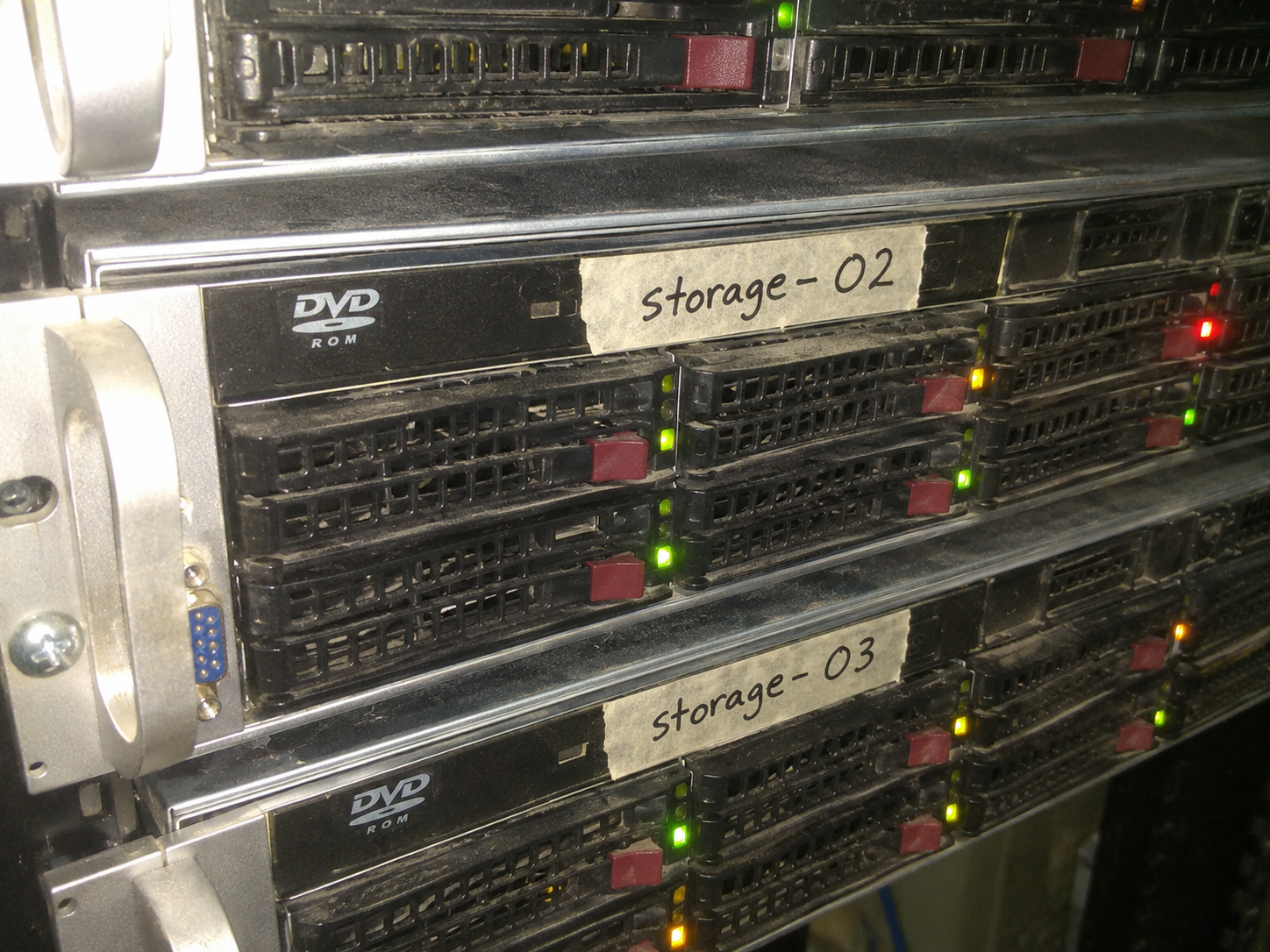
Close inspection of the drive bays on storage-02 and storage-03.
11:06 — Storage layout established
The engineer reconstructed the arrangement from controller inventories, network target mappings and saved logical-volume metadata. Local arrays had been divided into volumes, exported across the storage network and added to an aggregate volume group. Logical volumes within that group supplied the final block device presented to the hypervisor.
Each peer exported both its former data volume and a reserve volume over iSCSI. Those four exports and a local volume on storage-01 had been combined as five LVM physical volumes. Later capacity additions were appended as further linear segments rather than used to restore replication.
The allocation maps placed different ranges of the virtual disk on different servers. These ranges extended the disk’s capacity; they did not duplicate one another. Availability of the complete datastore therefore depended on all of its contributing storage remaining readable. Local array protection, where it remained intact, did not provide a second copy of the distributed device.
The installed arrangement was a single non-redundant distributed block device assembled from three machines. There was no other DRBD member containing the missing data, and no failover action could substitute one server’s contents for another’s. The original replication terminology had remained in use after the storage arrangement had changed.
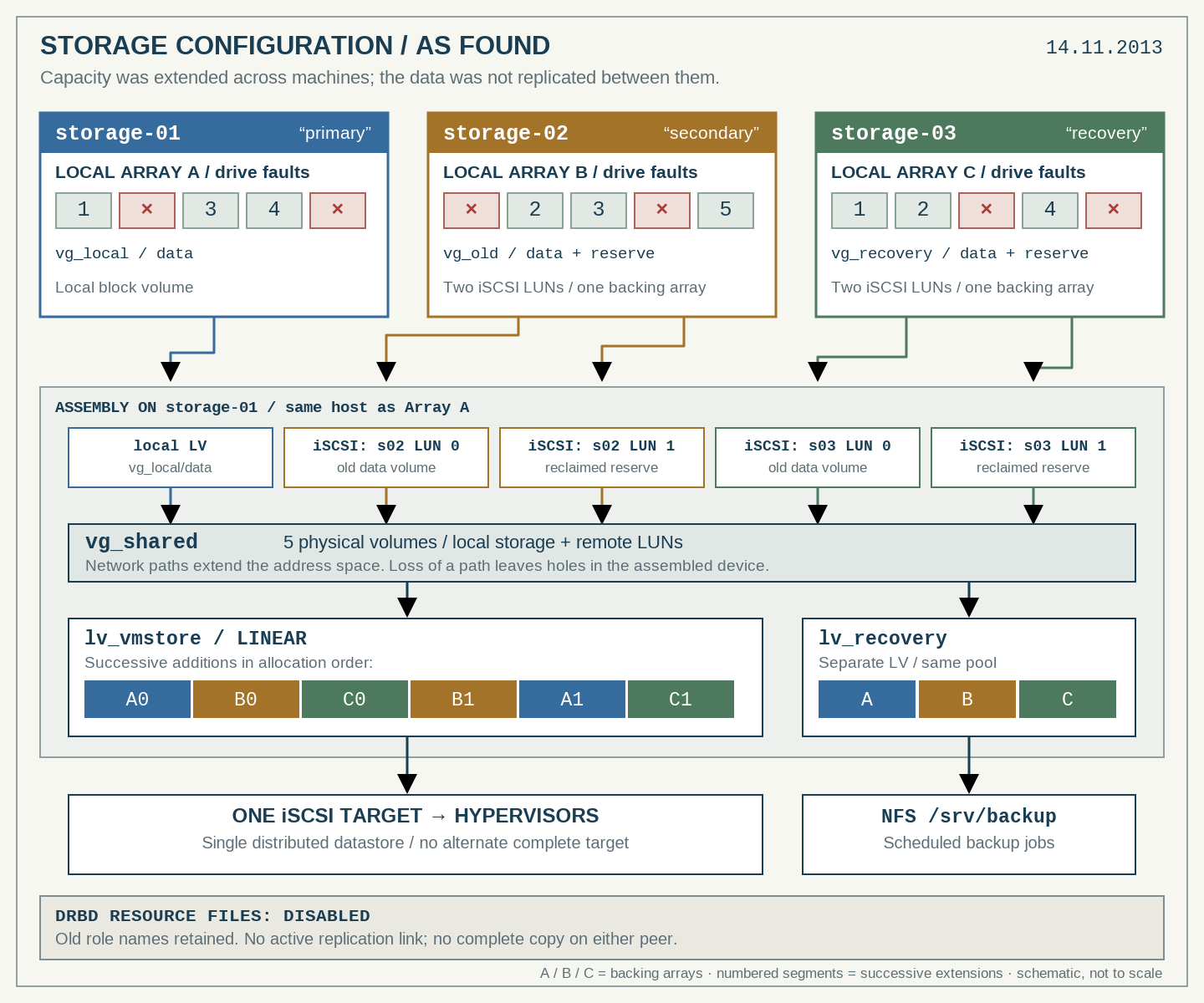
Reconstructed capacity layout. Separate iSCSI exports became LVM physical volumes on storage-01; production and backup volumes used the same pool. The old DRBD resources were disabled.
11:38 — Configuration history
The site manager advised that the HAWD engineer who had attended regularly until a few years earlier had been regarded as a genius. He had repeatedly increased the available storage without requiring the client to purchase additional hardware. Each increase had relieved an immediate capacity constraint and had been accepted as a successful maintenance outcome.
The surviving records showed a sequence of extensions and allocation changes rather than a documented replacement architecture. Capacity formerly associated with separate storage roles had been brought into the shared volume. The final arrangement was substantially larger than the original replicated dataset, but the handover material had not been revised to explain the change in protection.
The current site team had continued to interpret the presence of three powered storage servers as evidence that three copies existed. No recent exercise had demonstrated operation with one of those servers removed.
12:14 — Access and recovery assessment
Further work was limited to recording the allocation maps and assessing readable regions without initiating rebuilds. Attempts to inspect the datastore encountered missing extents, incomplete metadata and read errors across the volumes required by the principal virtual machines. Most of the production data could not be read through the assembled device.
Standard array recovery tools could interpret parts of the individual disk layouts but could not reconstruct the complete chain of controller volumes, network exports and subsequent logical-volume extensions. Filesystem recovery software required a coherent underlying address space which the field equipment could not provide. Supplying the surviving disks as a conventional array did not produce the original datastore.
The engineer obtained diagnostic records and configuration metadata, but no usable virtual-machine image or business-data archive. Further recovery would require examination of the original disks and controllers, followed by reconstruction of the allocation history in the laboratory.
13:07 — Backup position
The client’s scheduled backup jobs wrote to a volume described in the console as recovery storage. That volume was allocated from the same combined storage pool. It was logically separate from the production datastore but depended on the same underlying disks and network exports.
The backup catalogue could not be opened, and the client could identify no current offline or offsite copy. No independent set was available from which to restore the company’s application databases, customer records or working documents while laboratory recovery proceeded.
13:46 — Laboratory transfer agreed
The client authorised removal of the complete storage assembly to the London laboratory. Keeping the original disks, controllers and enclosures together was considered necessary because the configuration could not be represented reliably as a standard replacement array.
The three servers were shut down, their drive positions and connections were recorded, and each chassis was labelled for intake. The engineer packed the servers, associated storage components and connection records into the van. The hypervisor hosts remained at the client’s premises, powered down pending restoration of their datastore.
The separately retained field notes contained configuration information only. The failed storage assembly remained the sole physical source from which the client’s production data and backup contents might be recovered.
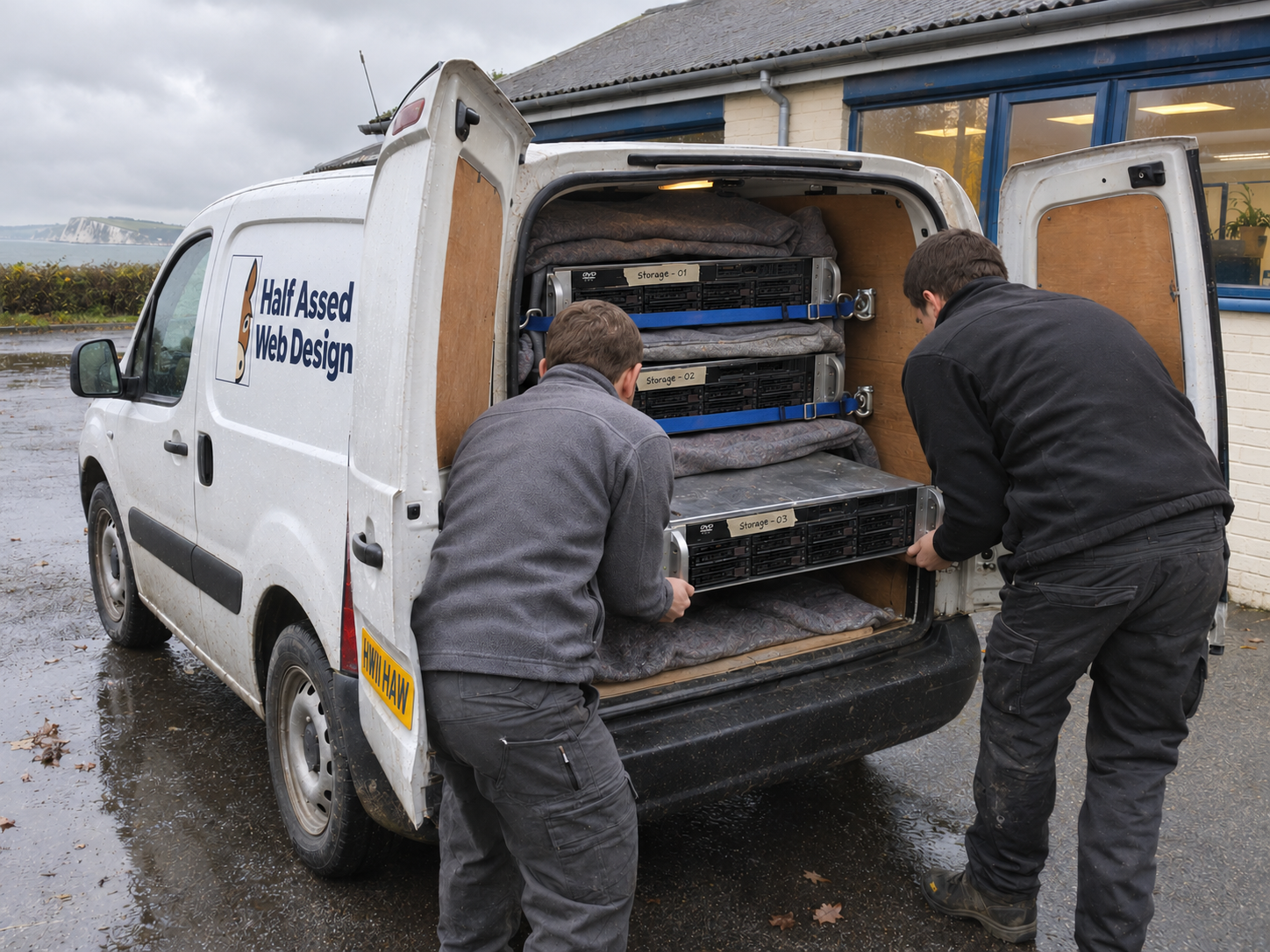
The three powered-down storage servers were packed into the small HAWD van for laboratory transfer.
16:18 — Departure from site
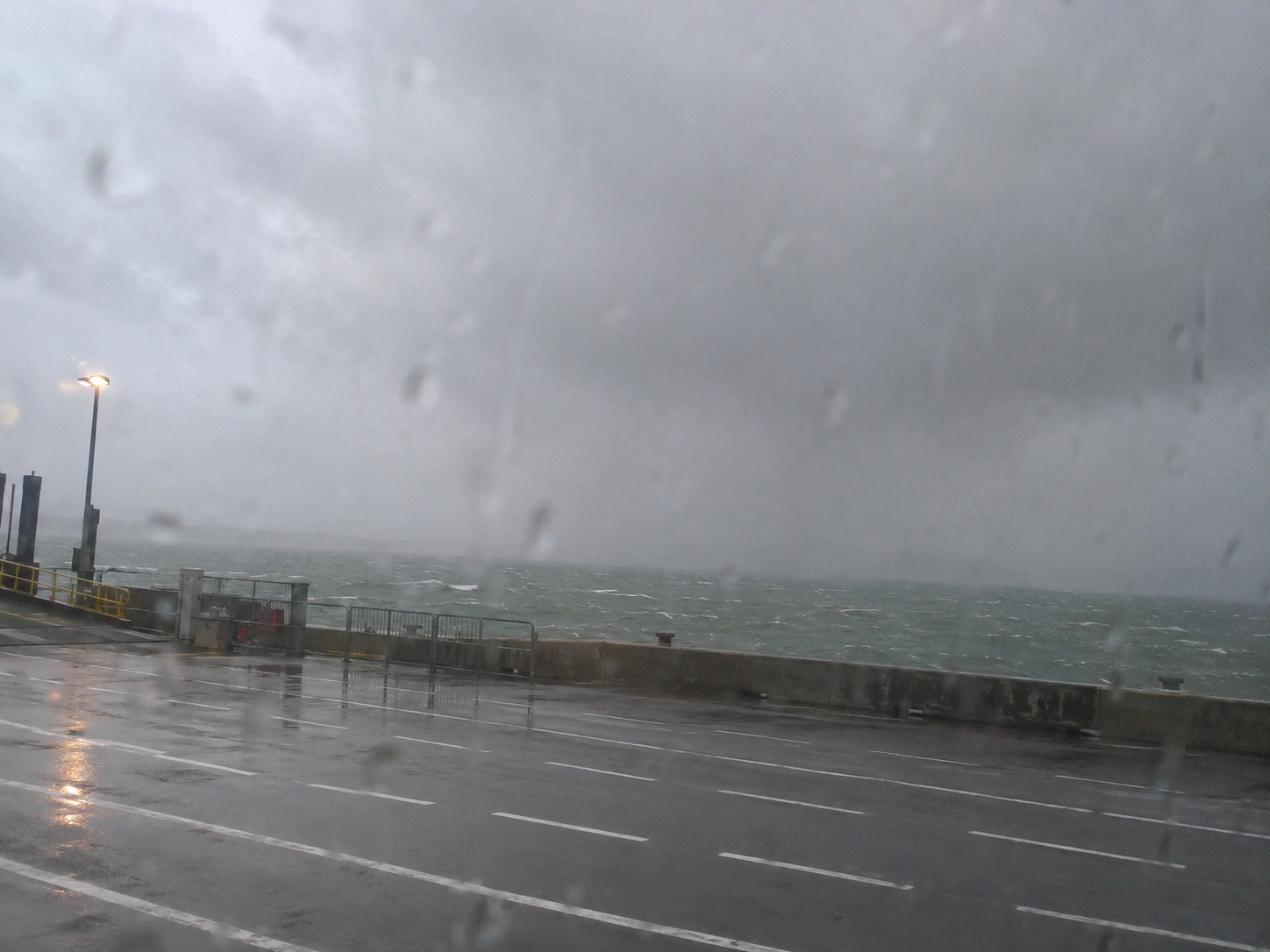
Weather conditions had deteriorated during the afternoon. The engineer contacted the ferry terminal before leaving the site and was advised that the crossing was close to cancellation. A final vehicle space was subsequently made available on a departing sailing, and the engineer was able to reach the terminal in time to take it.
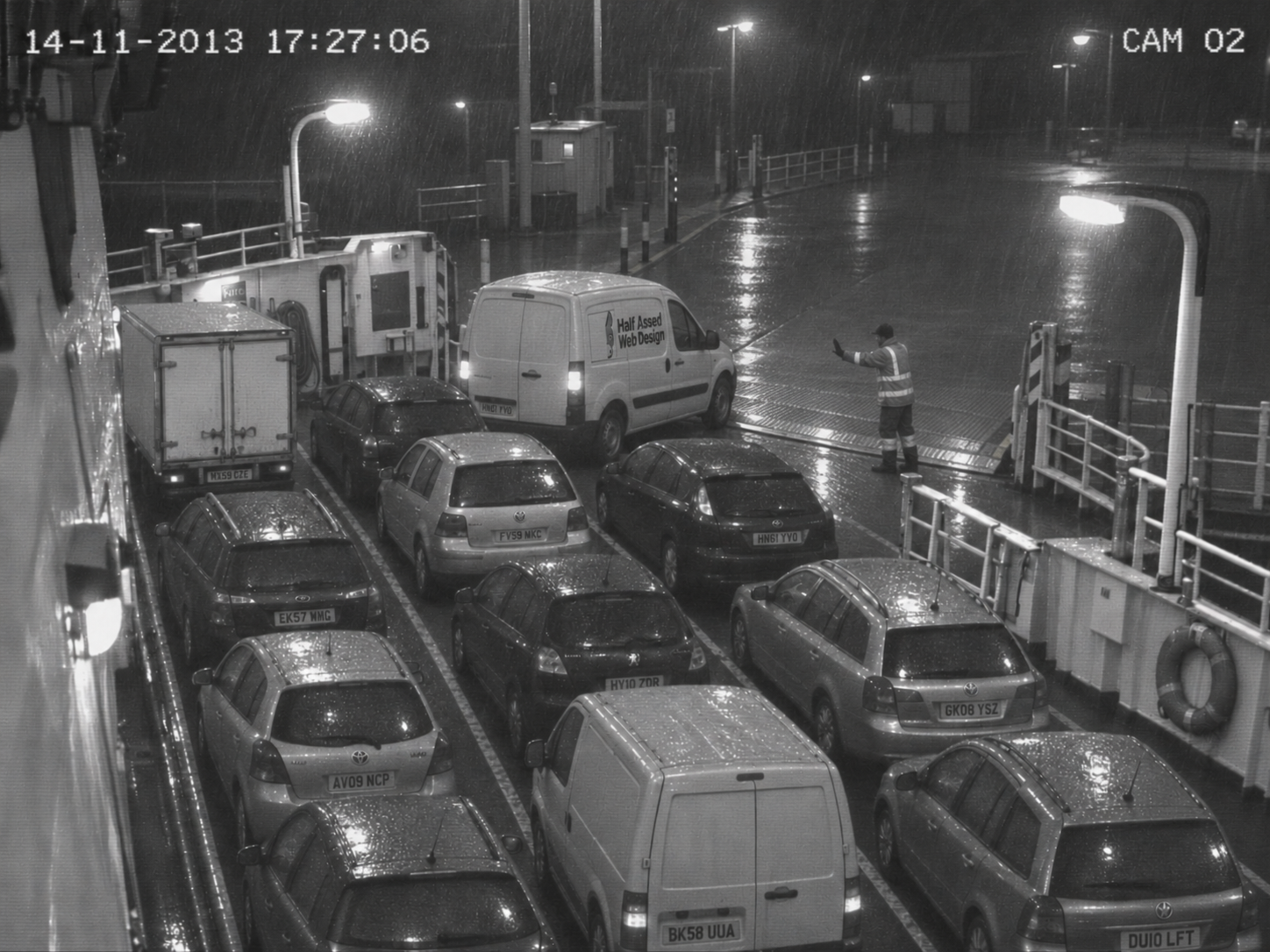
The ferry’s vehicle lanes were full, and the HAWD van was the last vehicle loaded. A deckhand directed the engineer to reverse into the remaining space immediately inside the loading barrier. The engineer applied the handbrake, locked the vehicle and moved to the passenger accommodation with his personal bag and service laptop. The packed storage assembly remained secured in the van’s load compartment.
17:32 — Crossing
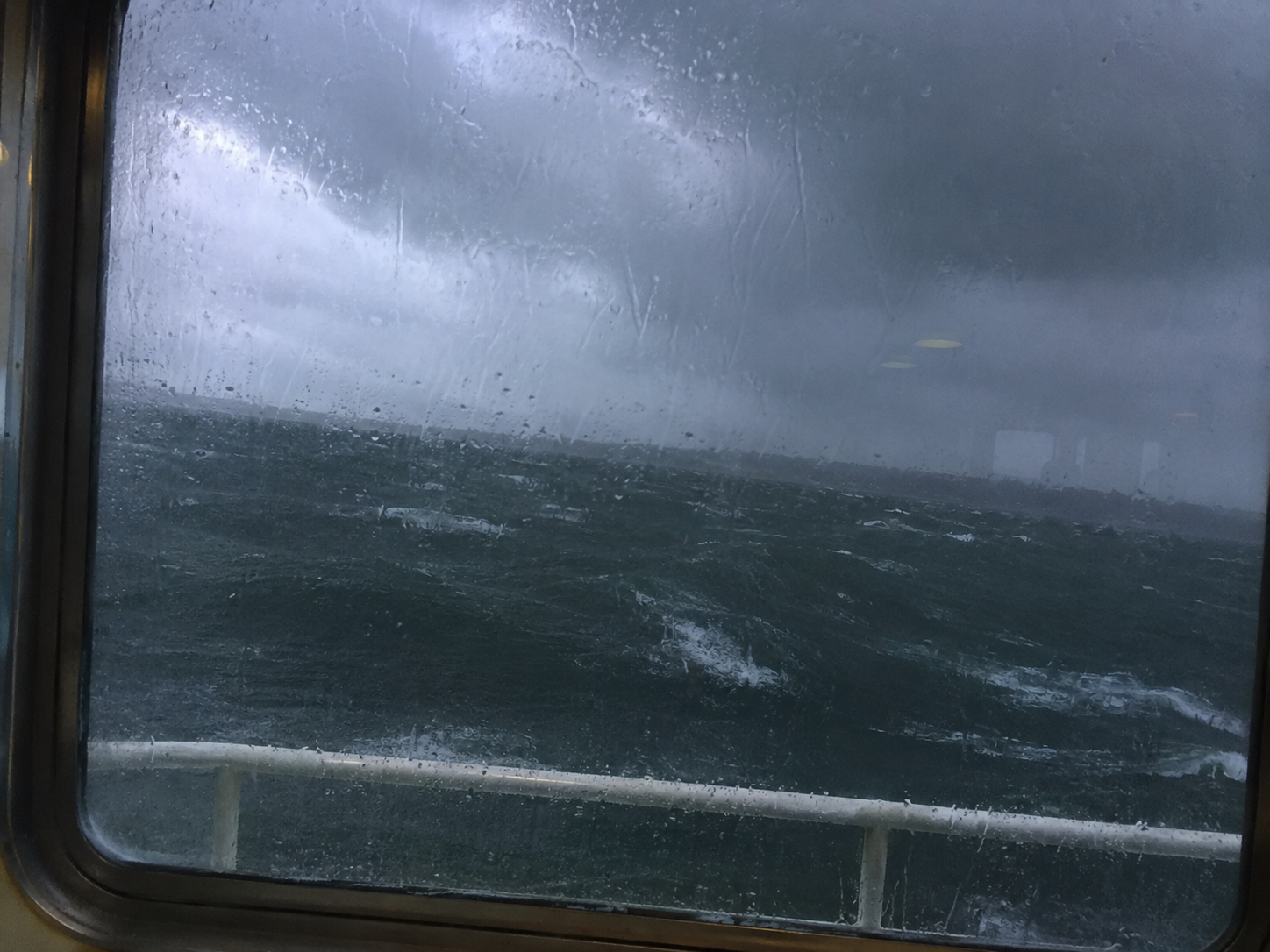
The crossing was short, but visibility over the Solent was poor. The vessel pitched noticeably during the passage, and the engineer remained in the passenger area. The van and its contents were not visible from his seat.
The London office was advised that the engineer had boarded and would continue by road after arrival. Laboratory intake remained scheduled for that evening, subject to the remaining journey time.
18:03 — Arrival delay
As the vessel approached the mainland terminal, staff announced that vehicle offloading would be delayed because of an incident. Passengers were asked to remain where they were until further instructions were issued. The initial announcement did not identify a vehicle or describe the incident.
The engineer made enquiries because the delay affected the laboratory handover. He was subsequently advised that a vehicle had moved from its position, passed through the loading barrier and gone overboard. Its position nearest the barrier had left little distance in which its movement could be arrested after the handbrake failed to hold.
18:24 — Vehicle identification
Further enquiries established that the vehicle was the HAWD van. The registration and loading position were confirmed against the engineer’s booking. All three storage servers and the associated recovery hardware were in the load compartment when it entered the water.
The engineer was in the passenger accommodation at the time. The immediate personnel check accounted for him, and the incident was recorded as a loss of vehicle and equipment. He informed the London office that the scheduled intake could not take place because the storage assembly had not remained aboard the ferry.
The client was notified that the hardware had been lost in the Solent and that the next step was to determine whether the vehicle could be located and recovered. No revised date for restoration of service was available.
17 November — CCTV review
HAWD obtained the ferry’s vehicle-deck CCTV footage as part of the incident review. The recording showed the van in the final loading position nearest the barrier, with the remaining deck occupied by parked vehicles. During the vessel’s movement it began to roll, continued into the barrier and passed beyond the deck edge.
The footage confirmed the identity of the vehicle and that it had gone overboard before docking. It did not show the van after it entered the water and provided no additional position from which a successful recovery could be arranged. The packed storage equipment was not removed from the vehicle before the incident.


20–22 November — Location and retrieval attempts
HAWD chartered a vessel to search the area identified from the ferry’s reported position and incident timing. The first search covered the estimated point of entry and the adjacent seabed. Poor underwater visibility and uncertainty over the van’s final position prevented a positive identification.
A further attendance extended the search area using the available position information. Several contacts were investigated, but none was confirmed as the missing vehicle. No server chassis, storage component or other item from the van was recovered.
The searches did not establish an accessible location for a lifting operation. The loss of the vehicle also prevented inspection of the handbrake mechanism; the incident record therefore distinguished the observed failure to hold the van from any unverified explanation of the underlying mechanical defect.
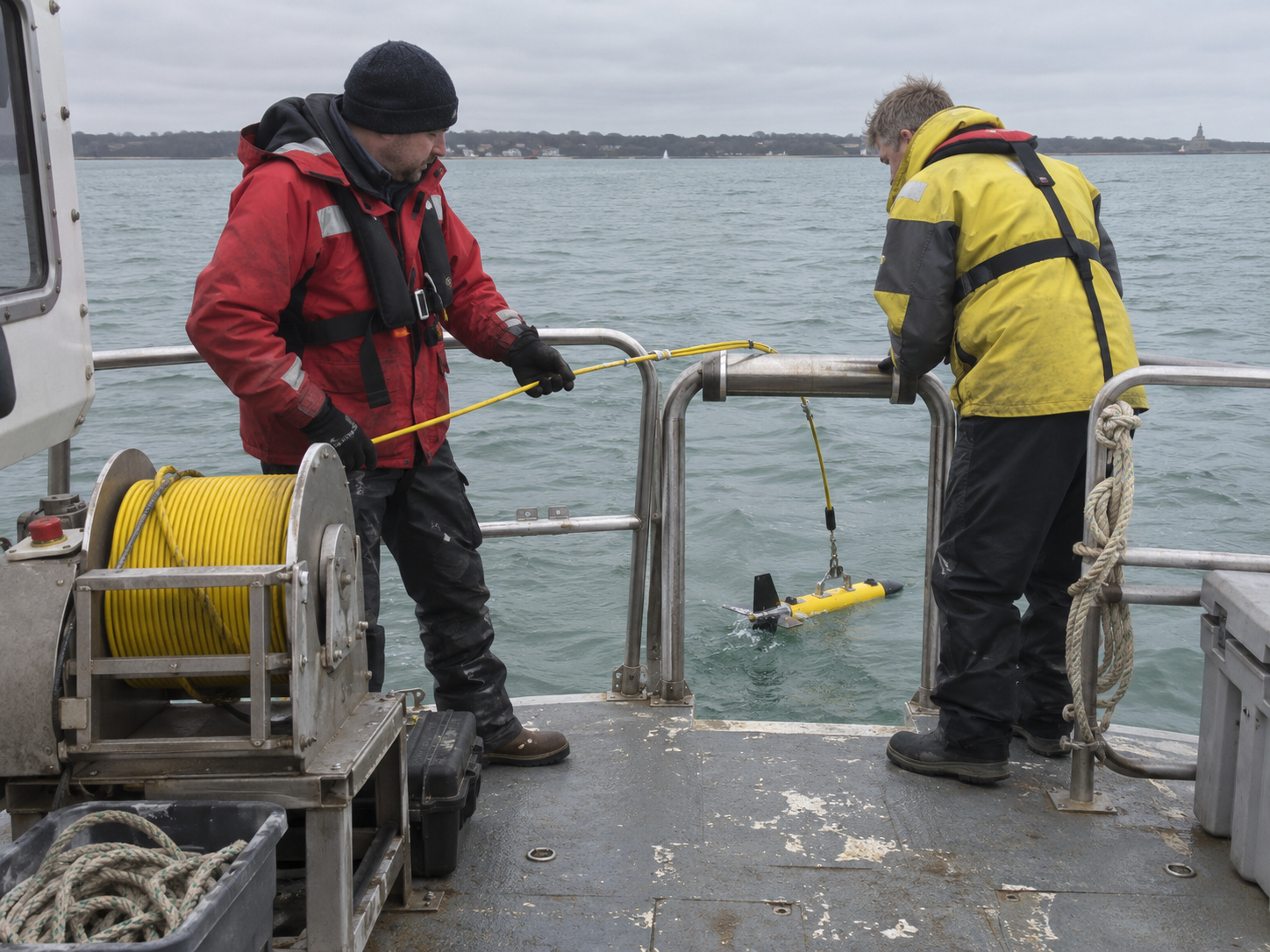
Deployment of survey equipment in the estimated search area.
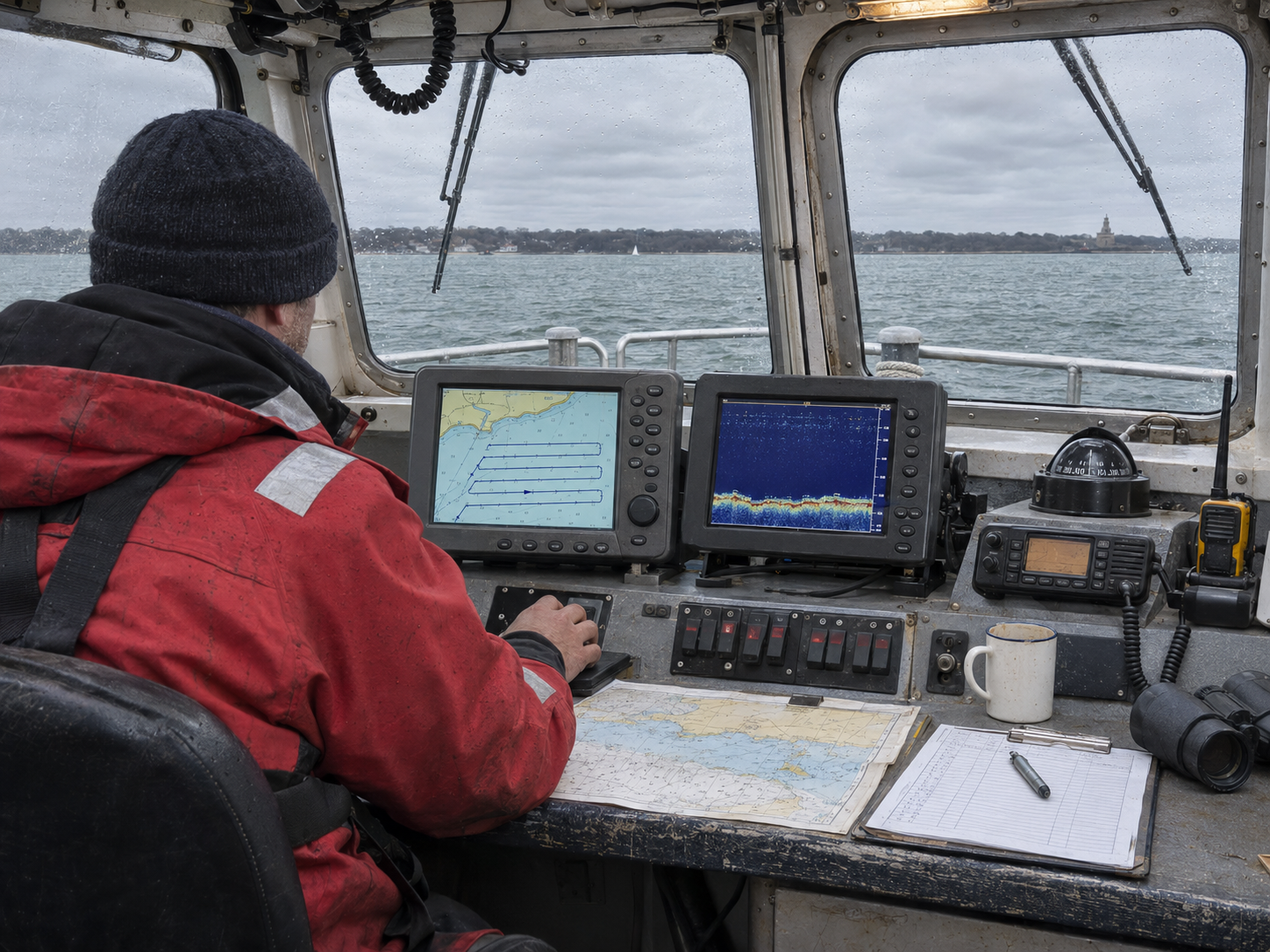
Search tracks and seabed returns reviewed aboard the chartered vessel.
24 November — Recovery position
| ORIGINAL FAILURE | Drive failures across the three contributing storage servers |
|---|---|
| REPLICATION STATE | No complete peer copy / capacity combined across the network |
| ONSITE RECOVERY | Configuration records obtained / no usable production dataset recovered |
| BACKUP LOCATION | Separate logical volume on the same failed storage pool |
| TRANSFER STATUS | All original recovery media lost with the vehicle during the crossing |
| SEARCH RESULT | Chartered-vessel searches unsuccessful / vehicle not located |
| LABORATORY STATUS | No hardware received / recovery cannot proceed |
The original array faults might have permitted some recovery after physical examination and reconstruction of the storage layout. That assessment could not be completed because none of the source media reached the laboratory. The retained configuration records described where data had been allocated but did not contain the data itself.
The client had no independent backup from which to resume operations. Both the production dataset and its locally held recovery archive depended on the disks in the missing vehicle. The unsuccessful searches left no available source for further recovery work.
The storage assembly was lost overboard with the engineer’s van during the return crossing. The vehicle has not been located despite searches using a chartered vessel. No usable data was recovered onsite, no independent backup is available and no original media has reached the laboratory. The case is closed with total data loss.